
FREE LIVE WEBINAR · THURSDAY 25 JUNE 1PM UK · FOR RETENTION LEADERS
You hold individual-level data on every customer. But CRM still markets to segments. Here's how to close that gap with Agents
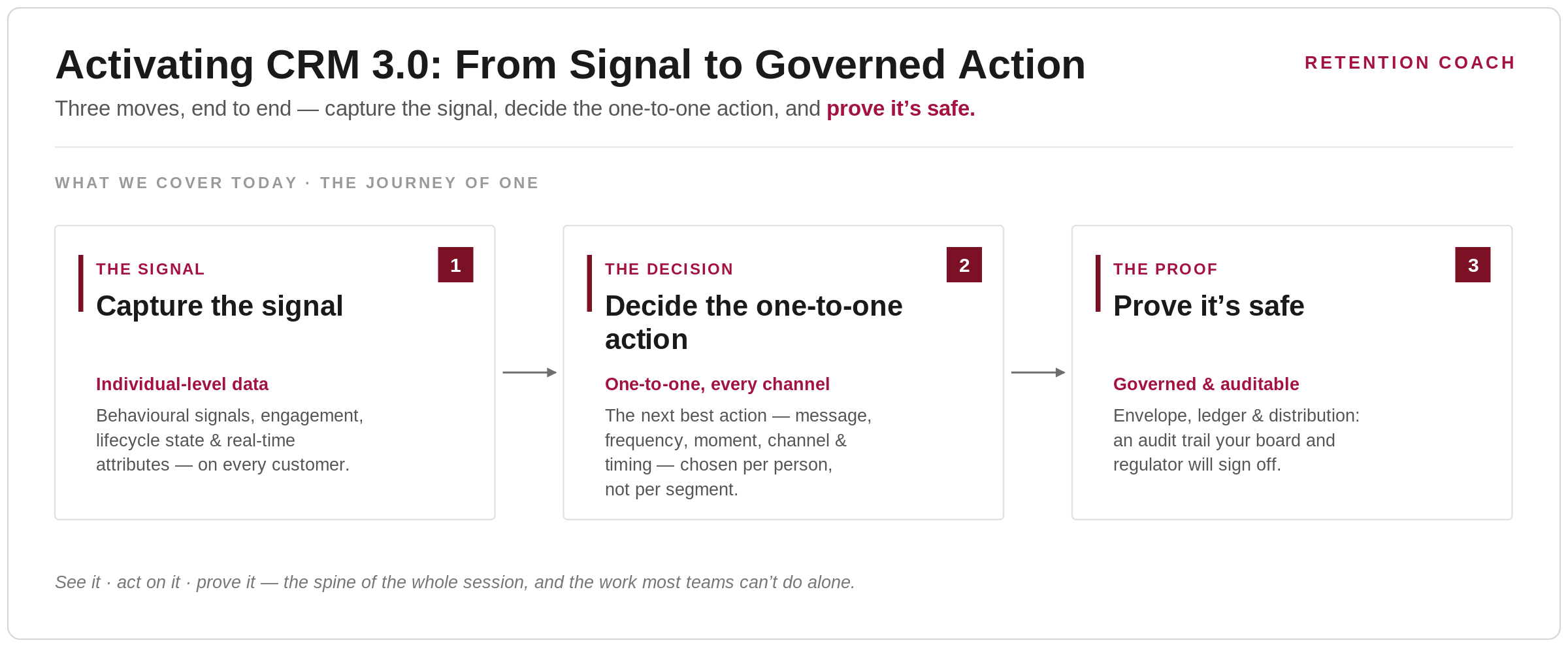
A 60-minute build session on how to turn individual-level data signals into genuinely one-to-one CRM marketing, the right message, frequency, moment, channel and send-time for every single customer, using the technology you already have.
Enter your email to save your seat
Live with Q&A · Replay sent to everyone who registers · ~60 minutes 📅 Thu 25 June · ⏰ 1PM UK / 2PM EU / 3PM ARABIA / 8AM EST · 🎥 Live + replay · 🎙️ Hosted by Tom Burrell
This isn't a hunch. It's where the analysts say the market is going.
Gartner
"60% of brands will use agentic AI to deliver streamlined one-to-one interactions by 2028" Gartner (Jan 2026)
Forrester
"Agents will use reasoning and planning to dynamically decide how to execute work" Forrester "Predictions 2026
You already have the signals. The question is what you actually do with them.
Most retention teams are now sitting on rich, individual-level data on every single customer: behavioural signals, engagement patterns, lifecycle state, real-time attributes, and the moments that matter. You can see, at the level of one person, what's happening and when.
But here's the gap: the data is individual, and the marketing is still built in segments and fixed journeys. You know this customer is cooling off, is most reachable on a Tuesday evening, has hit their content limit for the week, just crossed a moment of truth — and yet they get the same campaign, at the same cadence, on the same channel, as a hundred thousand others.
This webinar is about how to use those individual-level signals to drive a genuine one-to-one CRM marketing for every customer, what to send, how often, at which moment, on which channel, and when automatically. And how to govern it so the board signs off.
Today's personalisation tailors to a cohort.
One-to-one tailors to a person.
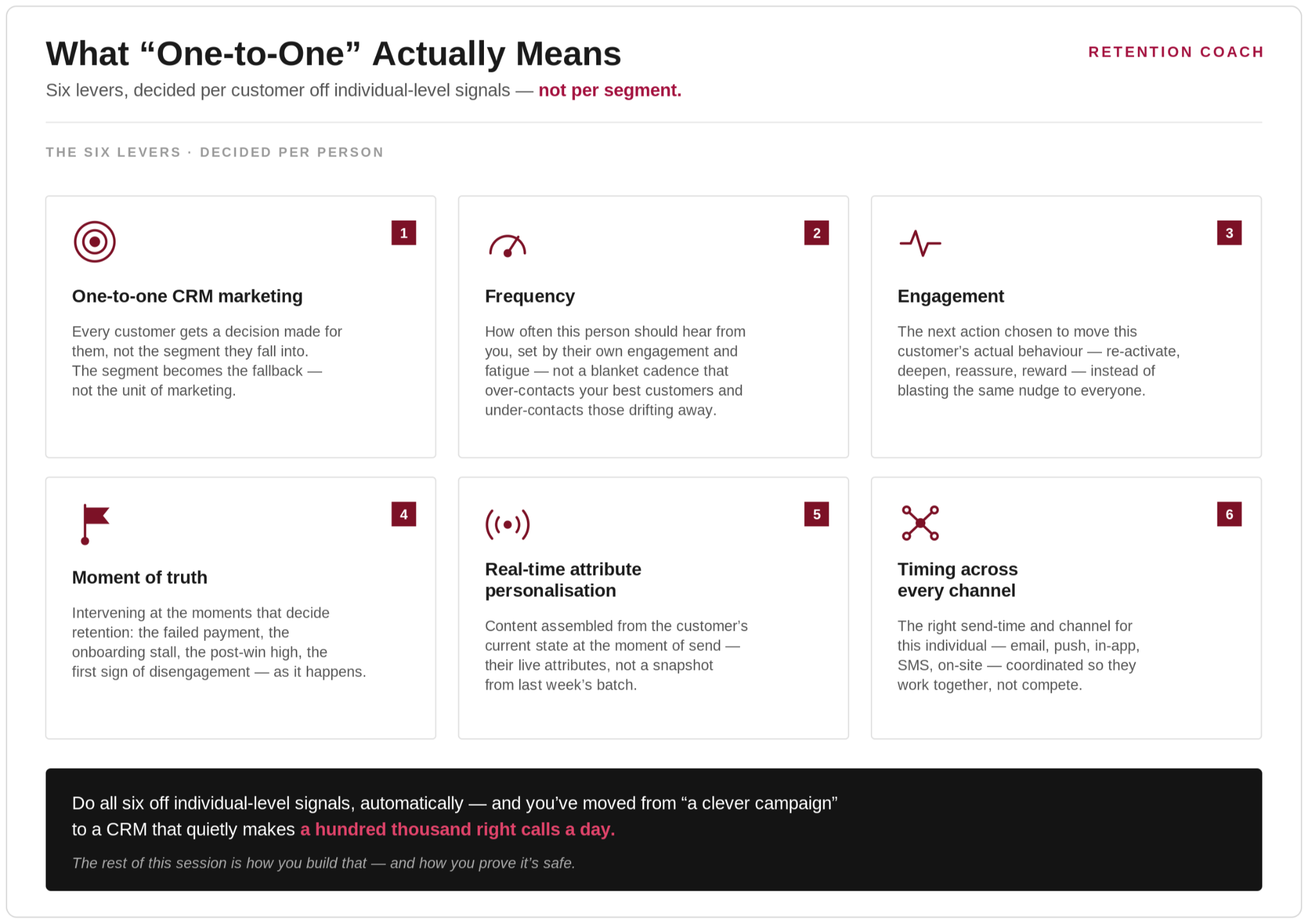
When the decision is made per individual instead of per cohort, six things stop being campaign settings and start being live, per-customer decisions driven off that person's signals:
- One-to-one CRM marketing: Every customer gets a decision made for them, not for the segment they happen to fall into. The segment becomes the fallback, not the unit of marketing.
- Frequency: How often this person should hear from you, governed by their own engagement and fatigue, not a blanket cadence that over-contacts your best customers and under-contacts the ones drifting away.
- Engagement: The next action chosen to move this customer's actual behaviour: re-activate, deepen, reassure, reward, rather than blasting the same nudge to everyone.
- Moment of truth: Intervening at the individual moments that decide retention: the failed payment, the onboarding stall, the post-win high, the first sign of disengagement for each customer as it happens.
- Real-time attribute personalisation: Content assembled from the customer's current state at the moment of send, their live attributes, not a snapshot from last week's batch.
- Timing personalisation across every channel: The right send-time and the right channel for this individual; email, push, in-app, SMS, on-site and coordinated so the channels work together instead of competing.
Do all six individual-level signals, automatically, and you've moved from "a clever campaign" to CRM marketing that quietly makes a hundred thousand right calls a day. This session is how you build that and how you prove it's safe.
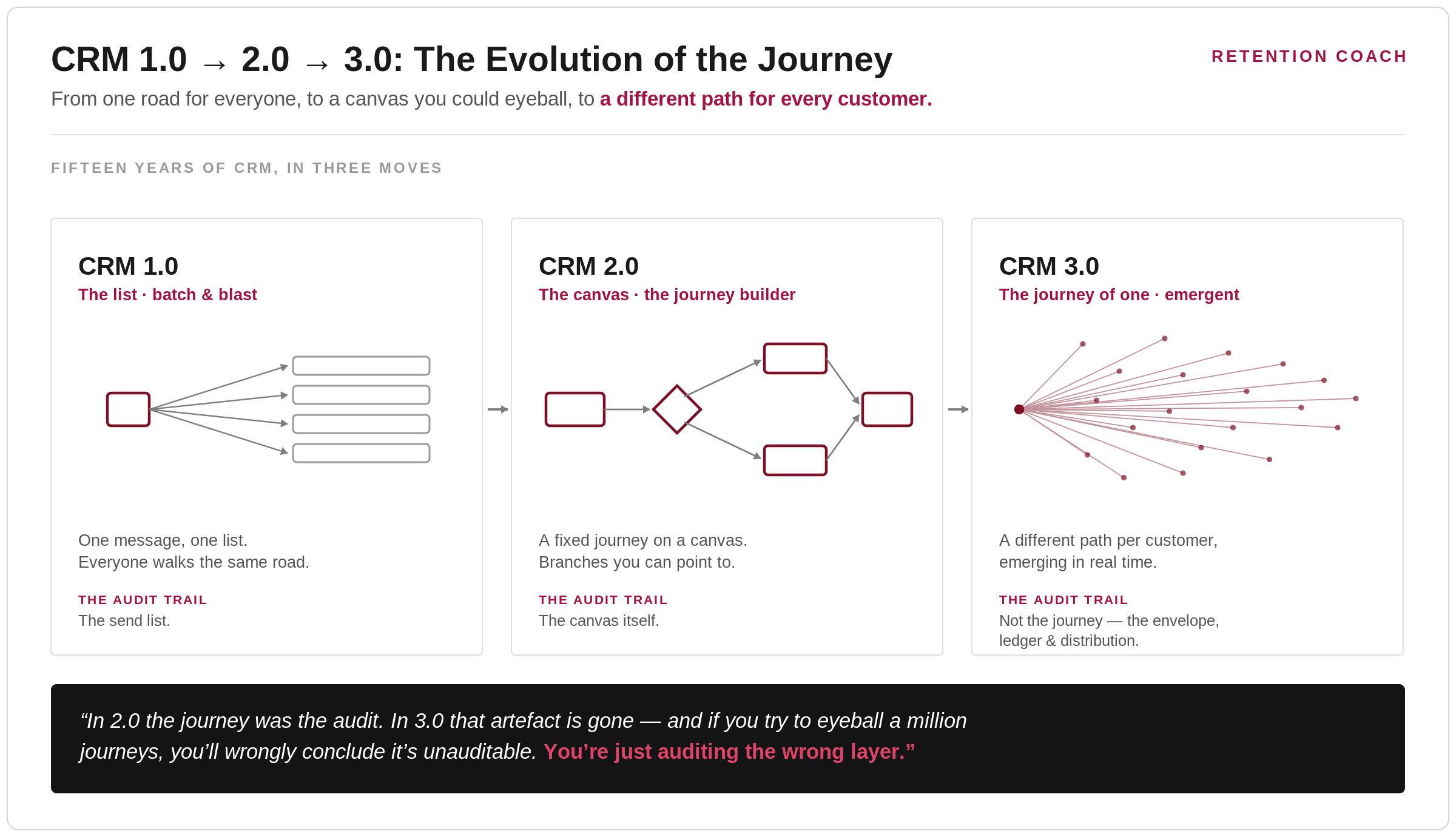
CRM 2.0 gave you a journey builder canvas you could eyeball.
Agentic CRM 3.0 takes it away.
For fifteen years, "doing CRM properly" meant building a better journey on a canvas. A fixed path, drawn out in a builder, that you could point to in a board meeting and say "here's what happens, and here's who gets it." The journey was the audit trail.
But a fixed journey can't keep up with a million customers drifting in a million directions. The moment decisioning moves up and out of the journey builder, the moment the path becomes emergent, different for every customer, that comfortable, eyeball-able canvas is gone.
And that's where most retention leaders freeze. Not because the technology doesn't exist. Because the second they imagine an agent making a million unsupervised decisions a day, they imagine the board meeting where they can't answer "why did it message Sarah six times?" and the project dies right there.
"In 2.0 the journey was the audit. In 3.0 that artefact is gone and if you try to eyeball a million journeys, you'll wrongly conclude it's unauditable. But you're just auditing the wrong layer."
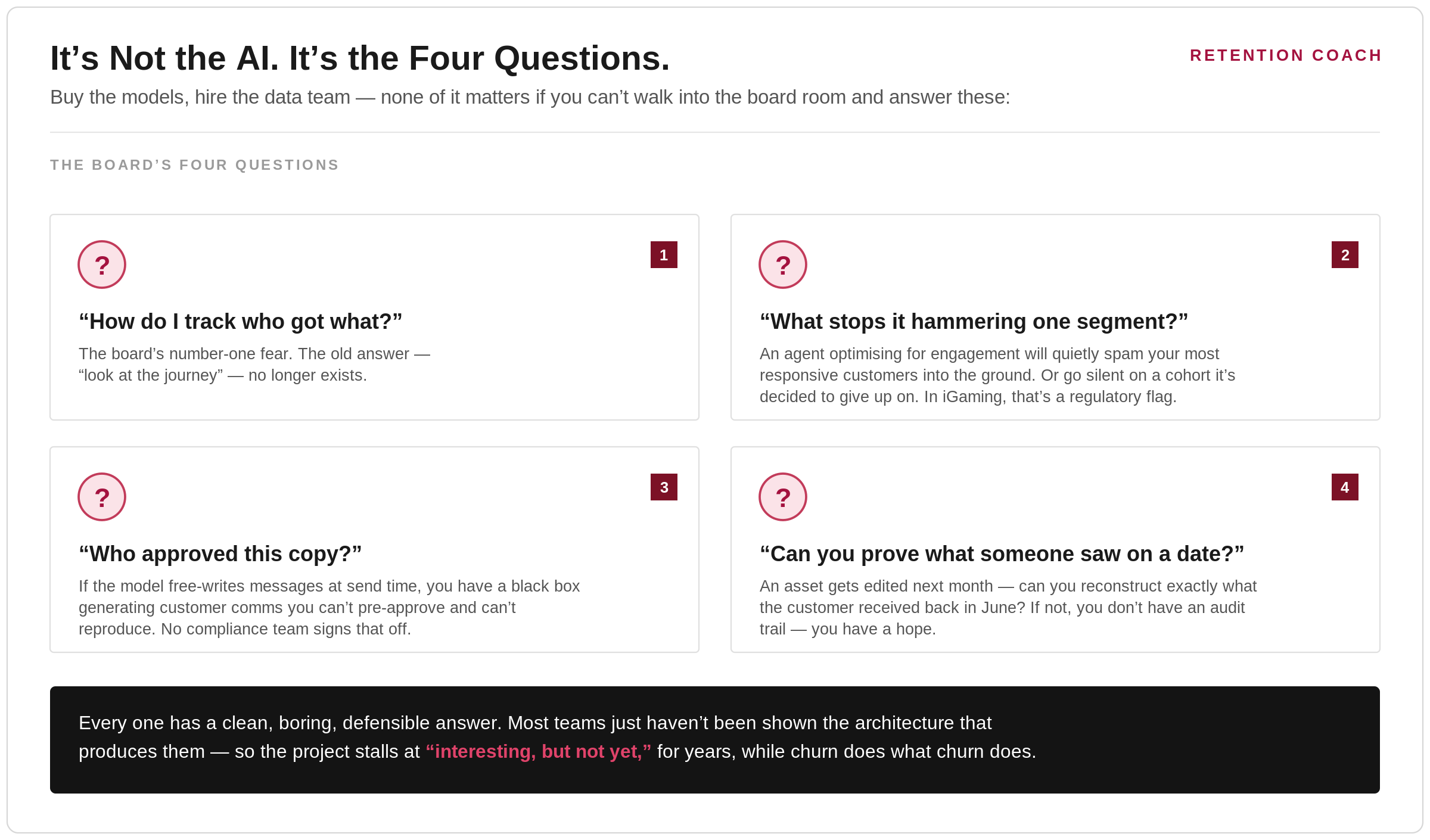
The reason these projects stall is the four questions no one can answer.
You can buy the models. You can hire the data team. None of it matters if you can't walk into the room and can't answer these:
Why most "agentic CRM" stalls
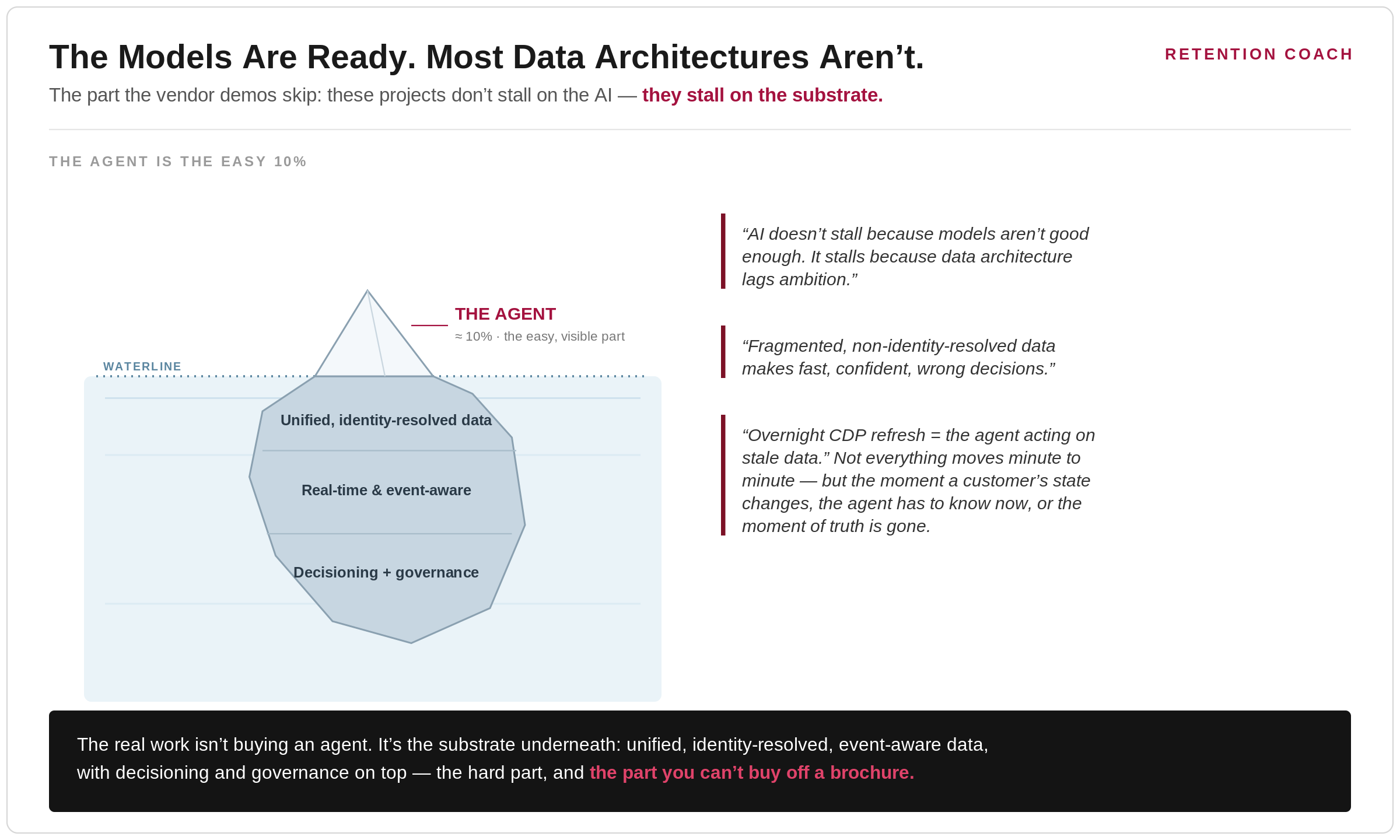
The models are ready. Most data architectures aren't.
Here's the part the vendor demos skip. The reason these projects stall almost never has anything to do with the AI:
"AI doesn't stall because models are 'not good enough.' It stalls because data architecture lags ambition."
When a human was in the loop, CRM could run on noisy, partial, segment-level data and nobody noticed. Hand the same data to an agent making a decision per customer, per session, and it fails loudly:"an agentic tool operating on fragmented, platform-reported, non-identity-resolved data will make fast, confident, wrong decisions."
And freshness becomes the new bottleneck: "most CDP pipelines refresh overnight, which means the agent is making decisions on stale data." Not everything needs to move minute-to-minute, but the moment a customer's state does change, the agent has to know immediately, or the moment of truth is gone.
So the real work isn't buying an agent. It's the substrate underneath it: unified, identity-resolved, event-aware data, with the decisioning and governance built on top. That's the hard part, and the part you can't buy off a brochure.
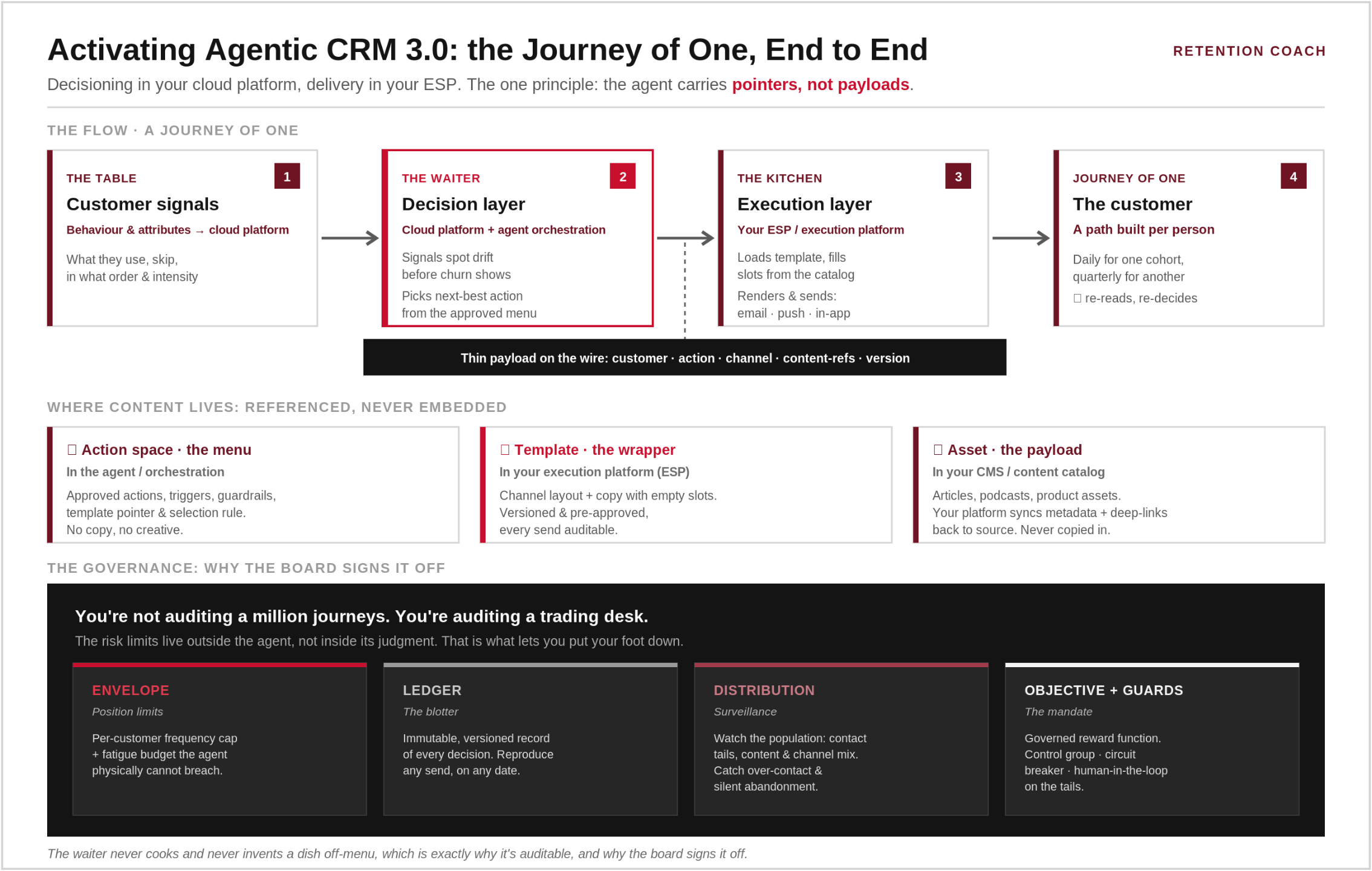
There's one principle that makes the whole thing governable: The agent carries pointers, not payloads.
It reads the customer's behavioural state, picks an approved action from a fixed menu, and emits a short structured instruction. It never stores content. It never writes content. It selects.
Once you accept that one move, everything that felt unauditable becomes boring and provable. The agent can't go off-script because it was never holding the script. And in this session, I'll show you exactly how that principle threads through the entire architecture and turns "the board will never approve this" into "the board signed it off."
Enter your email to save your seat
Live with Q&A · Replay sent to everyone who registers · ~60 minutes 📅 Thu 25 June · ⏰ 1PM UK / 2PM EU / 3PM ARABIA / 8AM EST · 🎥 Live + replay · 🎙️ Hosted by Tom Burrell
What you'll leave with from the session
Walk away with three things you can use on Monday.
1 · The end-to-end architecture The full picture: individual-level signals → decision layer (drift, propensity, next-best-action) → a thin wire → execution platform → the customer. How those signals turn into per-customer calls on message, frequency, moment, channel and timing. Mapped to real stacks, with examples.
2 · Where content actually lives The three places content sits in an agentic CRM, the action space, the template, the asset and why "referenced, never embedded" is the unlock that keeps one source of truth for everything.
3 · A governance model your board will sign off The Envelope, the Ledger, and the Distribution — the three things you audit instead of the journey, plus the control group, circuit breaker and human-in-the-loop that make it bulletproof. This is the part that turns the project from "blocked" to "approved."
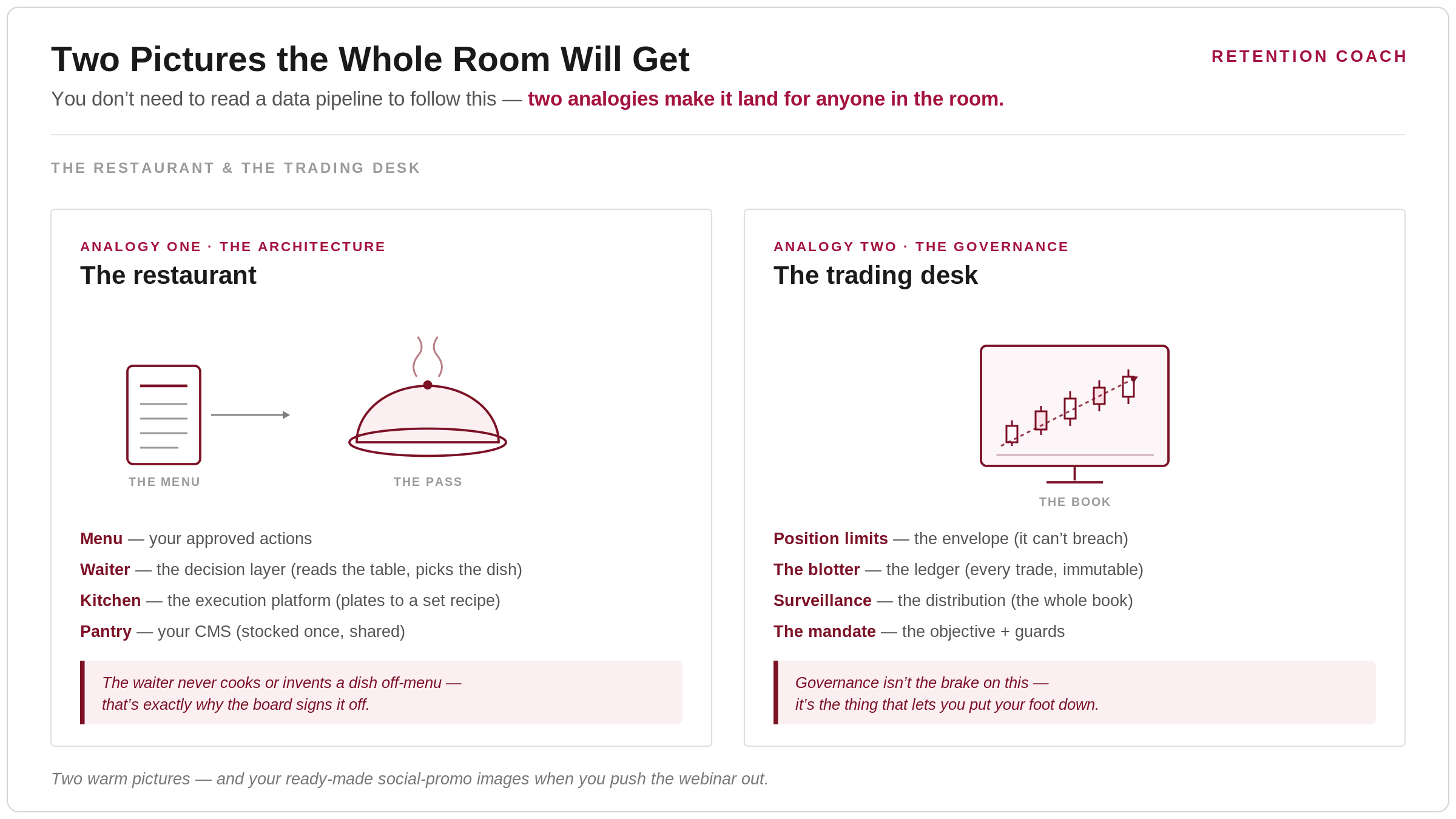
Two analogies the whole room will get
You don't need to be technical to follow this.
The session leans on two pictures that make this land for anyone in the room — including the exec who'll never read a data pipeline:
The restaurant. The menu is your approved actions. The waiter (the decision layer) reads the table and picks the dish. The kitchen (the execution platform) plates it to a standard recipe. The pantry (your content repository) is stocked shared. The waiter never cooks and never invents a dish off-menu, that's exactly why the board signs it off.
The trading desk. You're not auditing a campaign, you're auditing a trading desk. Position limits the trader can't breach (the envelope). An immutable blotter of every trade (the ledger). Compliance surveillance on the whole book (the distribution). Governance isn't the brake on this, it's the thing that lets you put your foot down.
Who this is for
This is for you if you're a…
- Retention, CRM or lifecycle leader in iGaming, Streaming, Sports or Subscription.
- Retention, CRM or iGaming leader carrying responsible-gambling, affordability and contact-control obligations.
- CCO, Marketing Director or Head of CRM who has to get the project past the board
- Martech, Data or RevOps lead who'll actually wire this together
Probably not for you if…
- You're happy with a fixed journey builder and aren't trying to move to per-customer decisioning yet
- You want a vendor pitch for a specific tool (this is stack-agnostic, bring your own)
Your host
Tom Burrell is a retention strategy consultant who works with Exco and P&L leaders in iGaming, Streaming, Sports and Subscription to structurally improve retention, and, increasingly, to stand up the agentic CRM architecture this webinar walks through. He works on priorities and execution at ExCo & board level. This session is the genuinely useful version of the work he does with clients one-on-one.
Tom's LinkedIn
What we'll cover in 60 minutes
1. The shift — CRM 1.0 → 2.0 → 3.0, and the one move that is the whole jump.
2. The principle — pointers, not payloads.
3. The architecture, end to end — signals → decision → execution → customer, with examples.
4. Where content lives — the action space, the template, the asset.
5. The trap to design out — why you never let the model free-write at send time.
6. The governance model — the Envelope, the Ledger, the Distribution.
7. Underneath it — the objective, the control group, the circuit breaker, human-in-the-loop.
8. How to actually start — the pragmatic maturity path, where governance is built in step two, not bolted on at the end.
9. What kills these projects — the failure modes, so you can avoid them.
10. Live Q&A — bring your stack, your regulator, your board's objection.
Aren't Klaviyo / Braze / Optimove / Bloomreach already doing this?
Your platform is getting agentic features. That's good, and it's not the same thing.
The execution platforms are adding real agentic capability, and that's a good signal, not a threat. Klaviyo's own co-CEO says the execution layer is moving to agents. But notice which layer is moving: the execution layer, the muscle. The harder, more valuable question is where the decisioning brain lives, and who owns it.
Forrester's distinction is the tell. Most of what's shipping is "agentish", AI bolted inside a deterministic, channel-bound flow, not reasoning-first decisioning. Or, as one practitioner put it, the platforms with the loudest agentic announcements aren't necessarily the ones with the cleanest substrate underneath.
The architecture in this session keeps the decision logic separate from the channel, one decision agent that email, push, in-app and on-site all call, so every channel acts on the same governed decision. (It's the principle leading practitioners are converging on: the channel should stay separate from the logic, so any channel gets the same decision.)
So how do you choose? Where your data and your customers already live inside one platform and the regulatory load is light, front-end agentic is the pragmatic, faster call, use it (e.g. e-commerce). Where your signal is spread across systems, and your board or regulator needs a defensible, version-controlled audit trail, the brain has to sit upstream and the platform becomes the execution muscle. This session is built for that second case: iGaming, streaming, subscription, sports and it's stack-agnostic: bring whatever you run.
"Keep the decisioning and its governance out of any single vendor's box. Rent the muscle. Own the brain."
Is this a sales pitch?
Will there be a replay?
I don't work in streaming, iGaming, subscription or sport, is this relevant?
Do I need to be technical?
Is it tied to specific tools?
How long is it?
Register now
This event wont be repeated.
Enter your email to save your seat
Live with Q&A · Replay sent to everyone who registers · ~60 minutes 📅 Thu 25 June · ⏰ 1PM UK / 2PM EU / 3PM ARABIA / 8AM EST · 🎥 Live + replay · 🎙️ Hosted by Tom Burrell